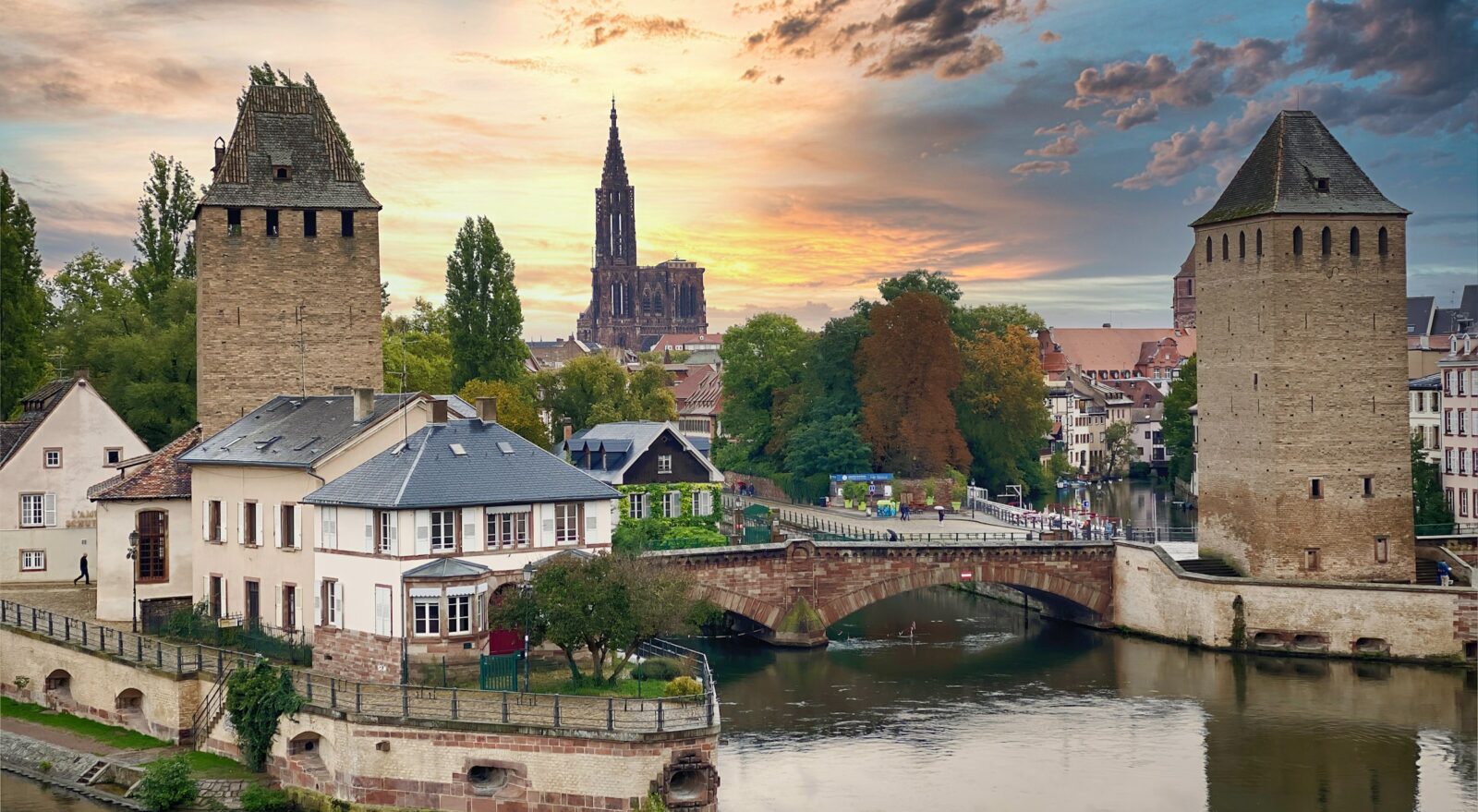
 Strasbourg ©Yevhenii Deshko – Unsplash
 Awarded the “Ville & Congrès de l’année – audience internationale” distinction by France Congrès et Événements, the event, which was bid on and won by IRCAD, a global training and research centre for surgeons, was not simply recognised for its operational success. It was acknowledged as a manifestation of something more structural: the alignment between a scientific community, a local ecosystem, and a global agenda.
From Event to Systemic Impact
At first glance, the congress had all the attributes of a major international gathering: 2,500 participants from 70 countries, a strong industry presence, and a programme structured around cutting-edge developments in robotic surgery and minimally invasive techniques.
Yet what distinguished this edition is the extent to which it functioned as a platform for systemic transformation. The announcement of a global initiative co-led by the World Health Organization, the IRCAD, and the SRS reframed the role of the congress itself. Rather than a space for dissemination alone, it became a site of institutional commitment.
The initiative addressed a well-documented global disparity: nearly half of the world’s population lacks access to essential surgical care. By mobilising telemedicine, robotic systems, and digital platforms, it sought to reconfigure access to care across geographies where medical expertise is scarce. In this context, Strasbourg is positioned as a node within a global response to structural inequities in healthcare.
A Territory Shaped by Its Own Trajectory
This positioning reflects a longer trajectory that has progressively defined Strasbourg as a centre of medical innovation. The reference point remains the “Operation Lindbergh” in 2001, the first transatlantic telesurgery performed between New York and Strasbourg, a milestone that effectively inaugurated a new paradigm in surgical practice.
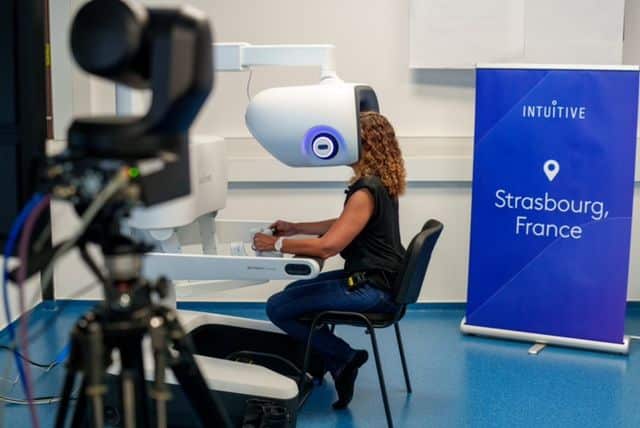
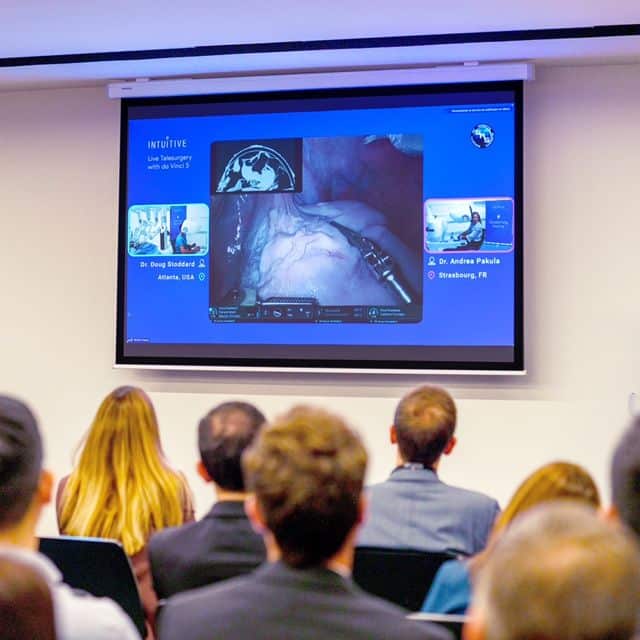
More than two decades later, the SRS congress reactivated this legacy as an operational continuity. Live demonstrations of transcontinental procedures (linking Strasbourg with Asia, the Middle East, and North America) extended the logic of telepresence into a new phase, where distance becomes increasingly irrelevant in clinical intervention.
In this sense, the congress amplified an existing ecosystem. The density of expertise concentrated around the IRCAD, described as the largest robotic surgery training centre globally, provided the scientific infrastructure upon which such events can build.
The discussions held in Strasbourg also reflected broader geopolitical concerns: workforce shortages in healthcare systems, unequal distribution of medical expertise, and the role of technology in mitigating these imbalances. By facilitating exchanges between regions as diverse as Europe, the Middle East, and Africa, the congress contributed to the construction of shared frameworks for addressing global health challenges.
Measuring Territorial Impact Beyond Economics
The territorial impact of the SRS congress is measurable in conventional terms. Increased hotel occupancy, extended stays by participants and accompanying persons, and the activation of local service providers all contribute to the regional economy. Approximately 20% of attendees extended their stay, indicating a spillover effect into tourism and leisure activities across the Alsace region.
However, reducing impact to these metrics would overlook the more enduring transformations at play.
Firstly, the congress reinforced Strasbourg’s positioning within what might be termed the “knowledge economy of cities.” With a university ranked among the world’s leading institutions in human biology and a concentration of Nobel laureates, the city’s scientific credibility is both validated and projected internationally.
Secondly, the event strengthened the integration between local actors, whether academic institutions, hospitals, industry partners, or event infrastructure. The ability to mobilise this ecosystem around a single event, with Strabourg Events (Strasbourg Congress Centre) leading the way, was itself indicative of a mature territorial model, where collaboration is embedded rather than constructed ad hoc.
Finally, the congress contributed to what can be described as reputational capital. By hosting pioneering demonstrations and facilitating high-level announcements, Strasbourg consolidated its image as a site where the future of a discipline is actively shaped.
Ramona Fisher, Chief Marketing & Business Development Officer at Strasbourg Events, says: “Strasbourg was proud to host SRS 2025, continuing the tradition of excellence set by previous destinations Miami and Orlando. The congress proved that our city, and venues like Strasbourg Congress Centre, are central to the global exchange of scientific knowledge. More than just a meeting, SRS 2025 created a lasting legacy that will resonate within the healthcare community for years to come and already left a significant impact on our destination.”
The Infrastructure of Knowledge
The role of the Palais de la Musique et des Congrès, managed by Strasbourg Events, in this process is way beyond logistical. As an institution, it functions as an interface between global knowledge flows and local capacity. Its sustained recognition, both nationally and internationally, reflects an ability to accommodate events that are not only large in scale but complex in their requirements.
More broadly, the congress infrastructure in Strasbourg operates as part of a wider system, linking physical spaces with intellectual production. The proximity between venues, research centres, and clinical environments enables a level of integration that is difficult to replicate in more fragmented urban contexts.
More information: [email protected] / www.strasbourg-events.com