For four days in late June, Glasgow’s Scottish Event Campus hosted the kind of gathering that usually stays exactly where it’s held: researchers, clinicians and pharmaceutical specialists filling lecture theatres to discuss the latest advances in brain science. The 37th World Congress of Neuropsychopharmacology brought roughly 800 delegates to the city between 26 and 29 June – its first return to the UK in more than 25 years – under a theme, “Advancing Brain Health Together,” that could easily have stayed a conference-room slogan. Instead, it walked out the door.
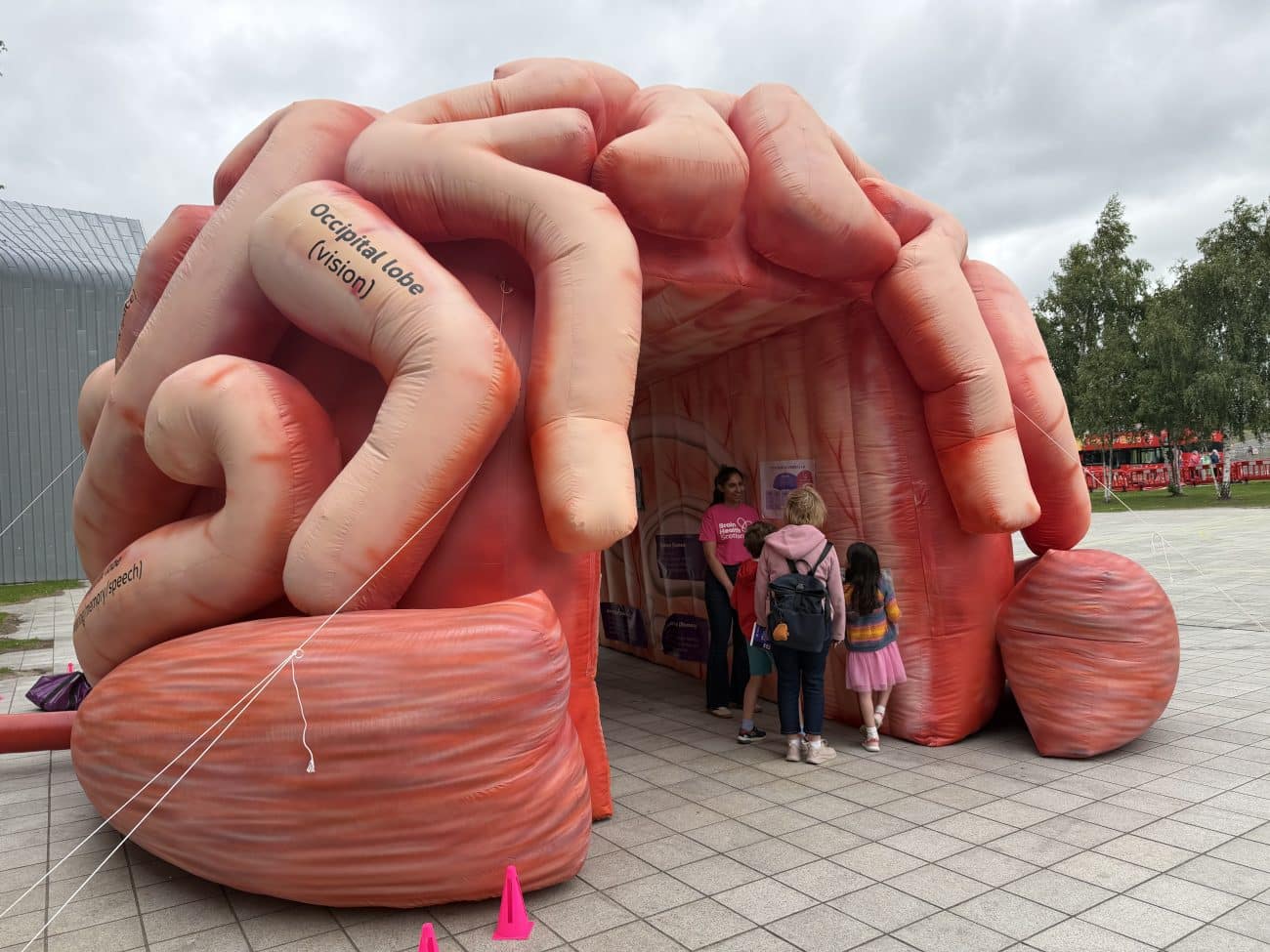
At Riverside Museum, a giant inflatable brain named Babs became the public face of the congress. Visitors stepped inside her (quite literally one might add, walking through the model) to explore how the brain works and what protects it over a lifetime. Around her, families crafted brain-shaped hats, pedalled bikes rigged to blend smoothies, and took turns at a digital piano, while trained staff and volunteers worked the room with practical advice on brain health. Almost 5,000 people came through Riverside Museum on the day the activity ran, with more than 250 engaging directly in the Babs the Brain programme itself.
The numbers that came out of it are the kind conference organisers rarely get to report. Of the 76 people who completed an evaluation survey on the day, 53 said they wanted to make a positive change to look after their brain health, and a further 16 said they were considering it, putting 69 of 76 respondents, over 90%, on the path to doing something differently because of an hour spent at a museum on a Saturday.
Public health moment
The event was delivered by Brain Health Scotland, an initiative of Alzheimer Scotland, with CINP, Glasgow Convention Bureau and city partners providing the connective tissue that turned a scientific congress into a public health moment. Glasgow Life gave over the Riverside Museum space free of charge; Scotmid backed Babs’s wider tour of Scotland and Northern England; and student volunteers from the University of Glasgow and University of Strathclyde received specialist training to help run the day. In short: training, and knowledge, that stays in the city long after the delegates have flown home.
That last point is where the story stops being about one good afternoon and starts being about legacy. “Glasgow is recognised as a world-leading centre for neuroscience research, so the theme of this year’s CINP Congress, ‘Advancing Brain Health Together’, presented a perfect opportunity to create meaningful impact beyond the conference itself,” says Aileen Crawford, Head of Tourism and Conventions at Destination Glasgow. “Glasgow Convention Bureau worked with local partners including Alzheimer Scotland, Brain Health Scotland, Glasgow’s universities and Riverside Museum to support a fun, family-friendly event where people could learn more about their own brain health.”
For Crawford, the response is evidence of something conference destinations increasingly have to prove, not just claim. “The response demonstrates the wider benefits that international conferences can bring to their host destination,” she says. “By connecting world-leading expertise with local organisations and communities, we can help create a positive legacy that extends well beyond the meeting room.”
Connection between expertise & community
That connection between expertise and community was the point for the scientists too, not an afterthought bolted onto their programme. Dr Christelle Langley, a CINP member and cognitive neuroscientist at the University of Cambridge, sees public engagement as inseparable from the congress’s stated theme. “The theme of this year’s congress was ‘Advancing Brain Health Together’, and an important part of that is ensuring scientific knowledge reaches beyond the conference and into the community,” she says. “Activities like this make cutting-edge research accessible and useful to members of the public, helping people understand how they can look after their own brain health.”
Katie Weldon, Community Engagement Officer at Alzheimer Scotland, describes Babs as a deliberate piece of design, built to lower the barrier to a subject people often avoid. “Babs the Brain is designed to make conversations about brain health engaging, accessible and relevant to people of all ages,” she says. “Bringing the activity to Riverside Museum gave families the opportunity to learn more about the brain through fun, practical experiences and to consider small changes that could support their brain health throughout life.”
What makes this worth watching beyond Glasgow is the model it points to: a congress that treated public legacy as a design brief, not a side event tacked onto a delegate programme. The trained volunteers from Glasgow’s two universities keep their expertise long after Babs deflates and moves on. The 69 people who said they’d change something are harder to track, but they’re the real return: a congress that measured success not only in delegate numbers, but in how many people, on one Saturday, decided to think differently about their own brains.