Recent research commissioned by the Bureau suggests the timing is right. Antwerp is widely recognised, yet familiarity with its actual meetings offer trails considerably behind general awareness. In other words, the challenge is less about putting Antwerp on the map than making sure planners know what is already there.
Pocket-Sized, Not Small-Minded
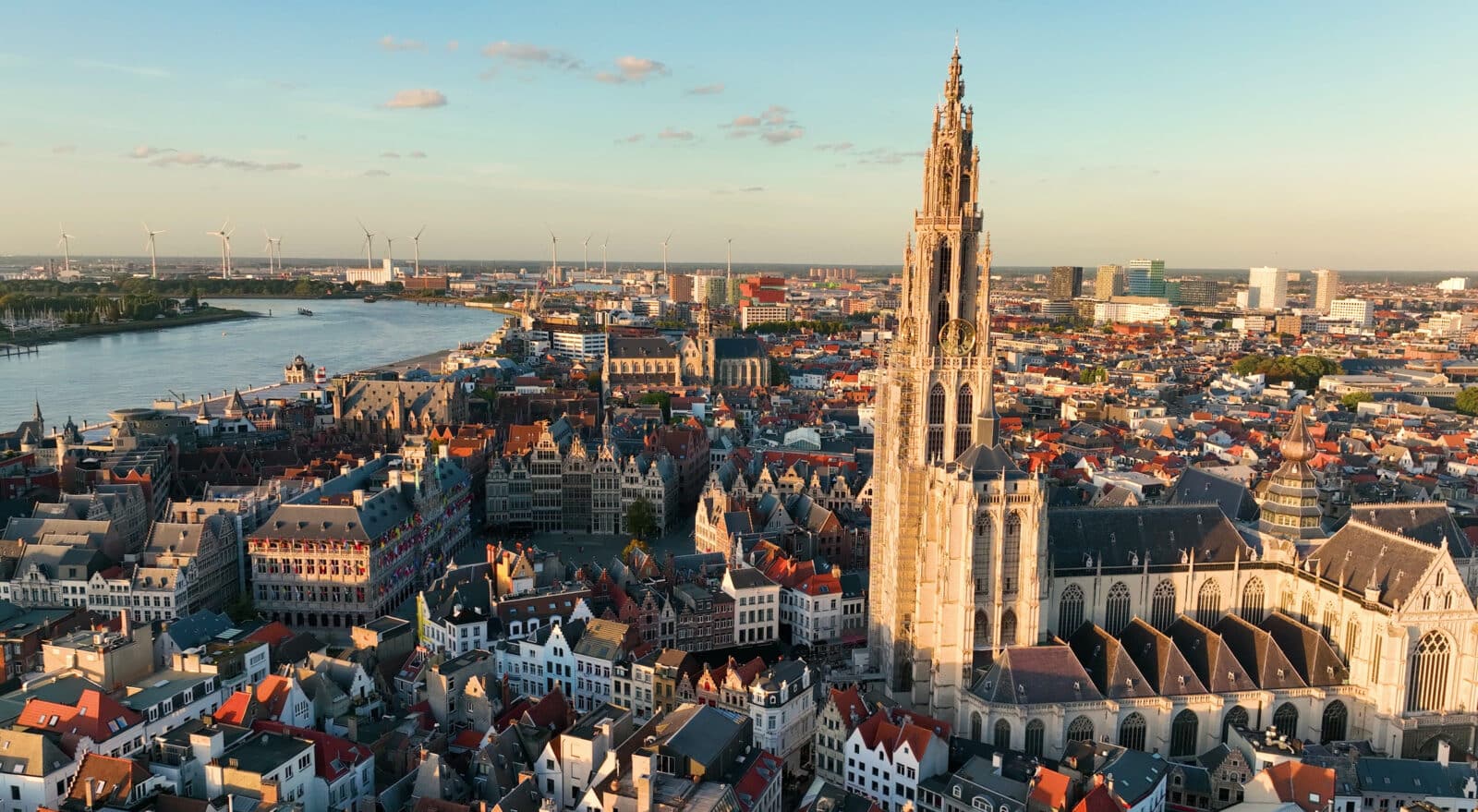
Antwerp describes itself as a “pocket-sized metropolis”, and for business events the apparent contradiction is rather useful. The city has the infrastructure expected of an international meetings destination, but without forcing delegates to experience it through shuttle buses, lengthy transfers and disconnected conference districts.
Its venue portfolio ranges from the restored Handelsbeurs, once home to one of Europe’s earliest purpose-built commodity exchanges, to A Room with a ZOO, where a convention centre sits alongside one of the world’s oldest zoos. AMUZ, housed in a former baroque church, offers another distinctive setting, while modern conference venues such as Vestar and KAVA complement the city’s broad range of meeting spaces.
Accommodation follows the same spectrum, from international names such as Hilton Antwerp Old Town, Radisson Blu Hotel and Crowne Plaza are complemented by distinctive properties such as Botanic Sanctuary Antwerp and August. Recent additions include Moxy Antwerp, Motel One Antwerp and Van der Valk Hotel Park Lane Antwerp, while Mercure Antwerp City South is set to become Pullman Antwerp later this year. Today, the city counts around 6,800 hotel rooms across different categories.
What changes the equation, however, is proximity. Once delegates arrive, venues, hotels, restaurants, heritage and much of the social programme sit within a relatively short distance. The city itself can become part of the programme rather than something glimpsed between transfers.
That compactness also helps answer one of the misconceptions identified by the Bureau’s perception research: accessibility. Brussels Airport is less than 35 minutes from Antwerp by direct train, while Antwerp Central provides international rail connections to cities including Amsterdam, Paris and London. The research nevertheless found connectivity to be one of the principal perceived barriers to selection – an interesting case of reputation lagging behind reality.
Being outside a capital, in this case, does not mean being out of the way.

Where Meetings Meet the Real Economy
There is another reason Antwerp warrants a closer look from associations; some of the conversations taking place inside its conference rooms are already taking place at scale outside them.
Start with the Port of Antwerp-Bruges, Europe’s second-largest port and one of the economic engines of the region. Then there is chemistry. Antwerp is home to Europe’s largest integrated chemical cluster, with hundreds of chemical companies operating in and around the city. For associations working across chemicals, circularity, logistics, maritime industries or supply chains, they offer access to companies, expertise and potential site visits that can turn a congress programme into something rooted in its host destination.
The same principle applies to health and life sciences. Antwerp combines a network of 28 hospital campuses with the University of Antwerp, the Institute of Tropical Medicine and Vaccinopolis, the specialist vaccine research centre. Its health ecosystem increasingly intersects with digital innovation, while the port itself plays a role in the life-sciences supply chain.
Technology provides another layer. Innovation communities such as The Beacon connect technology companies, researchers, government and the port around areas including AI, IoT and smart-city applications. Meanwhile, Antwerp’s globally recognised fashion and design scene adds a creative economy built around institutions such as the Royal Academy of Fine Arts. The city’s economic identity therefore stretches from heavy industry to haute couture; quite a range for a place that can largely be crossed on foot.
Antwerp’s opportunity is to connect congresses more deliberately with the local experts, companies, universities and institutions working in their fields. The Bureau’s own strategy identifies precisely this potential, with chemicals and circular economy, maritime and logistics, life sciences, and creative industries among the clusters capable of giving events a stronger local anchor.

A City That Doesn’t Need to Pretend to Be Bigger
Perhaps Antwerp’s strongest proposition lies in what it is not. It is not Brussels, Paris, Amsterdam or Vienna, nor does it need to compete with them. Its scale is part of the product.
The Convention Bureau’s research bears that out. Industry professionals consistently identified compactness, onsite logistics and walkability as genuine competitive strengths, alongside safety and visitor comfort. They also described Antwerp as “authentic”, “vibrant” and something of a “hidden gem”.
That creates an interesting position on the already crowded European meetings map: a city substantial enough to provide the infrastructure, accommodation and specialist knowledge international events require, yet compact enough for delegates to feel they have actually experienced it.
The role of the Antwerp Convention Bureau is to make those pieces work together. Its free, independent support covers venue and hotel sourcing, bid coordination, site visits, logistical guidance and introductions to local universities, economic hubs and other partners. In a city built on proximity, that connecting role feels particularly important.
That connecting role is also being strengthened through Antwerp’s Ambassador Programme, bringing together leading academics, medical experts, entrepreneurs and industry figures with strong international networks. By linking congress organisers with relevant local expertise, the Convention Bureau not only attracts events to Antwerp, but also gives them a meaningful connection to the city’s knowledge and economic ecosystems.
Ready to meet Antwerp again? Discover Antwerp for your next congress