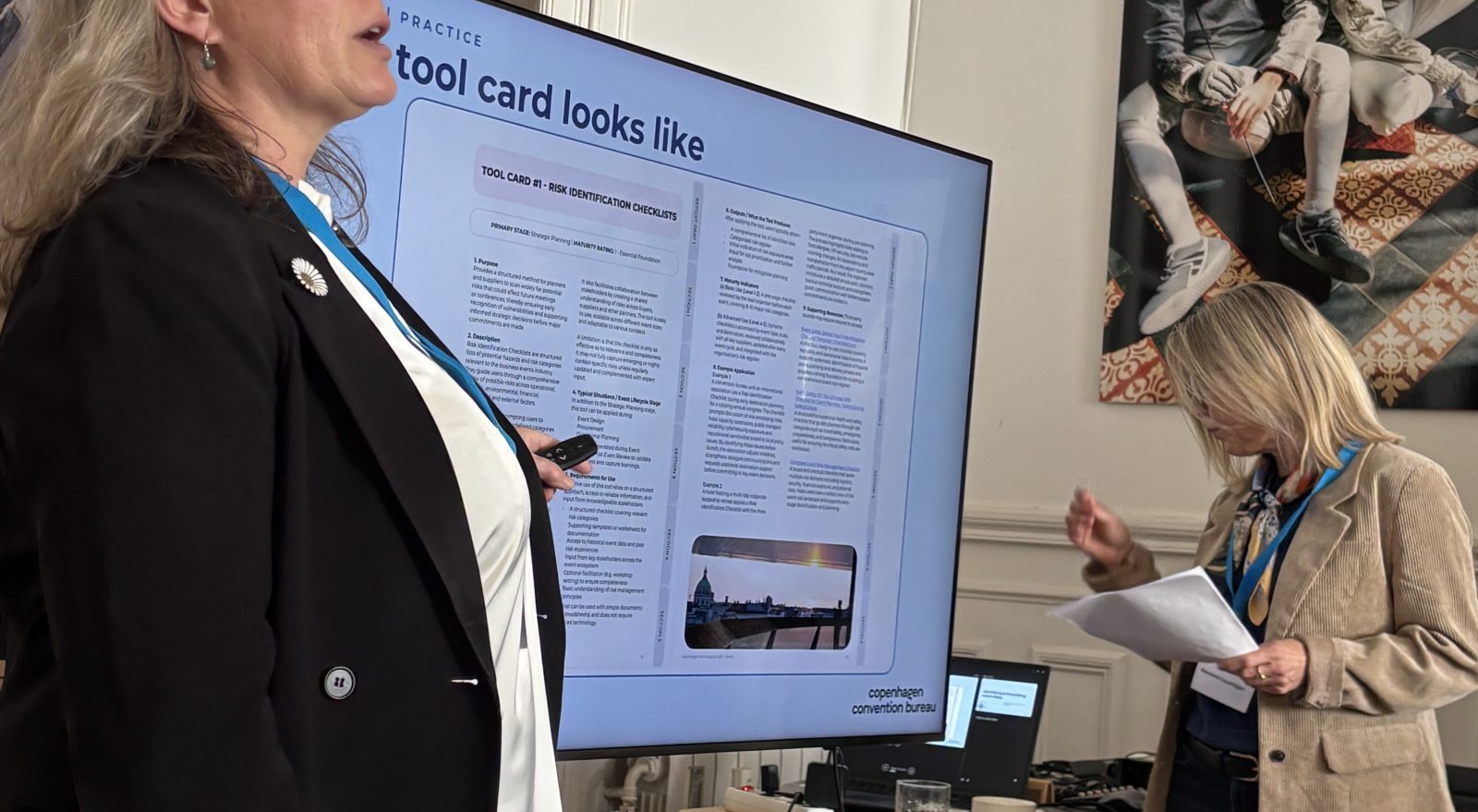
How prepared are associations to manage the unexpected? At a recent workshop organised by the European Society of Association Executives (ESAE) in collaboration with Copenhagen Convention Bureau, association professionals explored how to identify, prioritise and mitigate risks when planning international events.
Led by Bettina Reventlow-Mourier and Christina Wulff Lohmann from Copenhagen Convention Bureau, the interactive session introduced the recently launched Copenhagen Risk Navigator, a research-based resource offering 14 practical tools covering the entire event lifecycle.
Research presented during the workshop revealed that 43% of surveyed associations have no risk management strategy in place, despite events often representing a significant source of revenue.
Participants worked through two hypothetical scenarios. The first involved selecting a destination for an international congress, weighing economic uncertainty, geopolitical tensions, technological vulnerabilities and other risks. The second challenged groups to respond to a series of disruptions during an ongoing congress, from cyberattacks and severe weather to staffing shortages and contractual disputes.
Discussions highlighted practical mitigation measures, including clearer contractual responsibilities, contingency planning, stronger communication channels and better coordination between organisers, venues and suppliers.
A recurring message was that risk management is a shared responsibility, requiring cooperation across the entire events ecosystem rather than relying on individual stakeholders.
The workshop also emphasised the importance of moving beyond a blame culture towards one where organisations can openly discuss risks, learn from setbacks and build resilience.
The Copenhagen Risk Navigator is freely available to business events professionals worldwide.