Why life science matters for Copenhagen
Life science is one of Denmark’s recognised commercial strongholds and a major part of Copenhagen’s congress portfolio. According to the project briefing, life science congresses account for 43% of all congresses in Copenhagen. That gives the sector strategic weight for the city’s meetings industry, and it explains why congress development is now being linked more closely to cluster collaboration.
Denmark’s Life Science Strategy towards 2030 provides the wider policy context. The strategy aims to strengthen Denmark’s position as a leading European life science nation and contribute to a coherent, future-proof healthcare system. Its priorities include growth and innovation, improved use of health data, better adoption of innovation in healthcare, attractive conditions for production and investment, international cooperation and collaborative sector development.
The Greater Copenhagen life science setting
Copenhagen is part of Medicon Valley, the bi-national life science cluster spanning Eastern Denmark and Southern Sweden. The area includes universities, hospitals, science parks, biotech, pharma, medtech and contract research organisations. Medicon Valley Alliance acts as the cross-border cluster organisation, supporting collaboration through networks, events, projects and advocacy.
At national level, Danish Life Science Cluster adds another layer. It describes itself as Denmark’s national cluster for life science and welfare technology, connecting companies, research institutions and organisations. The Danish Life Science Cluster is a key driver of the Business Lighthouse Life Science initiative that was established in 2023 with funding from the Danish Government. The initiative is a business promotional effort aimed at strengthening public-private collaboration in the healthcare sector and develop new solutions through the ‘lighthouse’ partnership model. The initiative creates public-private partnerships and collaborative projects between the healthcare sector, knowledge institutions, municipalities and innovative small and medium-sized enterprises.
As part of the lighthouse initiative, Copenhagen has also developed a shared international positioning through Copenhagen Life Science, a collaboration between the public sector, private life science companies and universities. The platform presents Copenhagen as a place where academia, industry and the public sector work together to develop health solutions, support companies and strengthen export potential.
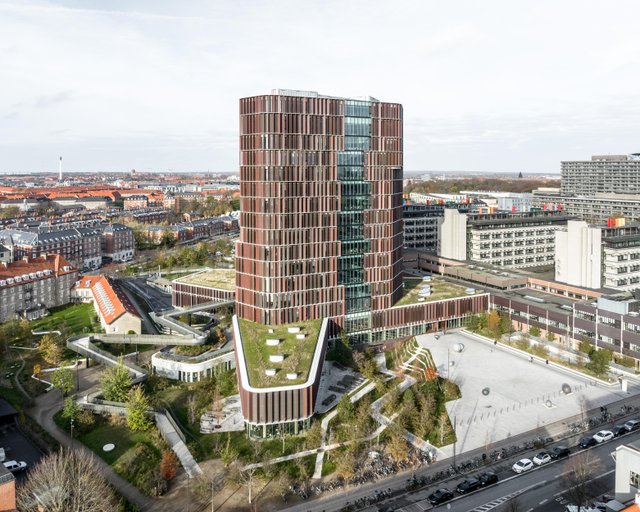
One of the most visible physical expressions of this ecosystem is Innovation District Copenhagen. Anchored in five institutions for research and education, the district gathers researchers, students, clinicians, start-ups and established companies around leading academic and clinical institutions within the fields of medicine, health and natural sciences. Its offer includes knowledge communities, research facilities, start-up environments and networking opportunities. For congress organisers, these structures can help identify local expertise and create meaningful links beyond the official programme.
Furthermore, a new partnership between the University of Copenhagen and Healthcare Denmark has just been established with the aim to strengthen international collaboration and promote the Danish ecosystem globally. The collaboration supports Innovation District Copenhagen, where research, healthcare, industry, public actors, and investors work together to accelerate innovation. and emphasize translating world-class research into solutions that deliver societal value and future healthcare advancements. Together, the partners enhance Denmark’s global position through knowledge sharing, partnerships, and engagement with international delegations.
Complexity as a reason to collaborate
A strong sector is not automatically easy to navigate. Copenhagen and Greater Copenhagen have many relevant actors, but their priorities, resources and expectations are not always the same. This is precisely why the Valuable Meetings project is relevant.
As Jane Nøhr, Head of Unit – Research, Collaboration & Community, Danish Life Science Cluster, explains: “The Danish life science sector is strong and internationally competitive, but it is also a complex and fragmented ecosystem with many actors, diverse needs, and barriers to collaboration. Realising the sector’s full potential requires greater coherence, trust, and stronger partnerships across companies, the healthcare system, knowledge – and educational institutions.”
International meetings can create moments where disciplines, organisations and markets intersect. They bring external expertise into the city, but they can also help local actors find each other around a specific topic, disease area, technology or professional field. For Copenhagen Convention Bureau, this means moving beyond the traditional destination pitch and help shape the conditions in which they can create broader professional value.
Valuable Meetings as the bridge
Valuable Meetings runs from October 2024 to September 2027. Its purpose is to strengthen Denmark’s international position in the congress and meetings market while supporting innovation, internationalisation and growth in selected Danish strongholds. The project establishes partnerships between Danish congress destinations and clusters, including the collaboration between Wonderful Copenhagen and Danish Life Science Cluster.
In Copenhagen, the shared goals include making better use of international scientific congresses, strengthening exchange between research and business, mobilising relevant stakeholders, improving communication about the value of congress participation and increasing access to talent. The collaboration also aims to improve the value proposition towards congress buyers and Danish small and medium-sized life science companies.
For Danish Life Science Cluster, the project has prompted a more concrete view of congresses. As Nøhr adds: “The project “Valuable Meetings”, supported by the Danish Board of Business Development (ERST), focuses on cluster and destination collaborations aimed at attracting more international congresses as well as strengthening and spreading the value of these congresses throughout the ecosystem. It is a highly rewarding and eye-opening project that challenges us in Danish Life Science Cluster to think concretely about the value of congresses for our members and to remain attentive to the synergies that can arise when specific disciplines and interests intersect – creating new opportunities and increased innovation.”
The project also connects with Wonderful Copenhagen’s 2030 strategy, Copenhagen, All Inclusive, which looks at tourism through its wider social, economic and environmental effects. Applied to business events, that approach shifts attention from delegate numbers alone to the relationships, knowledge exchange and sector value a congress can help generate.
For associations, Copenhagen’s offer is therefore becoming more precise. The city is not simply presenting venues and a strong life science profile. It is developing a model in which congresses can be connected to clusters, companies, hospitals, universities and innovation environments in a systematic way.
Want to create more value from your next congress in Copenhagen? Connect with Copenhagen Convention Bureauto explore how your meeting can engage the city’s life science community before, during and after the event.