 ©Daph & Nico – Tourisme Montréal
 Long Before the Doors Open
Some of the Palais’ most important work happens when there is no event in sight yet. Its Business Intelligence team continuously tracks international congresses and their rotation patterns, looking several editions ahead to understand when an event may next return to North America. It is a deliberately proactive approach in which the team identifies where the city has a credible case to make and starts putting the pieces together.
Those pieces often include a local champion. The Palais can support those individuals through the bidding process, while bringing in Tourisme Montréal and other partners able to strengthen the proposition.
For Luc Charbonneau, Vice-President, Business Development and Strategic Alliances at the Palais, this ability to rally different players around an opportunity is one of Montréal’s defining advantages: “What makes Montréal different is how naturally people come together around an opportunity. The Palais, Tourisme Montréal, universities, research centres, business organizations and local leaders each bring something different to the table. Rather than working in silos, we combine our strengths and expertise around a common goal.”
It is an approach that has produced measurable results. In the latest Union of International Associations ranking, Montréal retained its position as the leading city in the Americas for international meetings for a ninth consecutive year, recording 89 qualifying meetings in 2025. The ranking is evidence of a system that works.
Winning an international congress is rarely the work of one organisation. The local expert brings credibility and subject knowledge; destination partners bring their networks and resources; the Palais contributes intelligence, event expertise and a detailed understanding of what will ultimately be required to deliver the congress. And that collaboration does not disappear once the bid is won.
From Venue to Working Partner
Associations have become more demanding about what a congress needs to accomplish, partly because their delegates have too. “Associations aren’t simply asking where they can hold their next congress,” Charbonneau says. “They’re asking where it can have the greatest impact and how they can create a memorable experience for their delegates.”
That shifts the conversation beyond square metres and room capacities. Networking, smaller conversations and opportunities to make meaningful professional connections now sit alongside the formal programme. At the same time, associations are under mounting financial pressure, with increasing costs, while registration fees cannot simply rise indefinitely.
But perhaps the more interesting role for the Palais is as a connector. The same ecosystem mobilised to win a congress can become part of the event itself. Researchers, businesses, institutions and communities relevant to an association’s field can be brought into the conversation, opening up possibilities for knowledge exchange and collaboration that would be difficult for an international organiser to establish from afar. It means the expertise that helped bring an event to Montréal can also help shape what happens once it gets there. As Charbonneau puts it: “We don’t simply bring an event to the city. We bring the city’s ecosystem around the event.”
The venue and its services help bring that wider ambition together in practical terms. The Palais’ dedicated team works alongside organisers, while its turnkey meeting-room packages, developed with its audiovisual partner, integrate screens, sound, lighting and connectivity rather than requiring organisers to assemble those elements separately. Its 113 multipurpose rental spaces across seven floors provide the flexibility to accommodate different formats and ways of bringing people together.
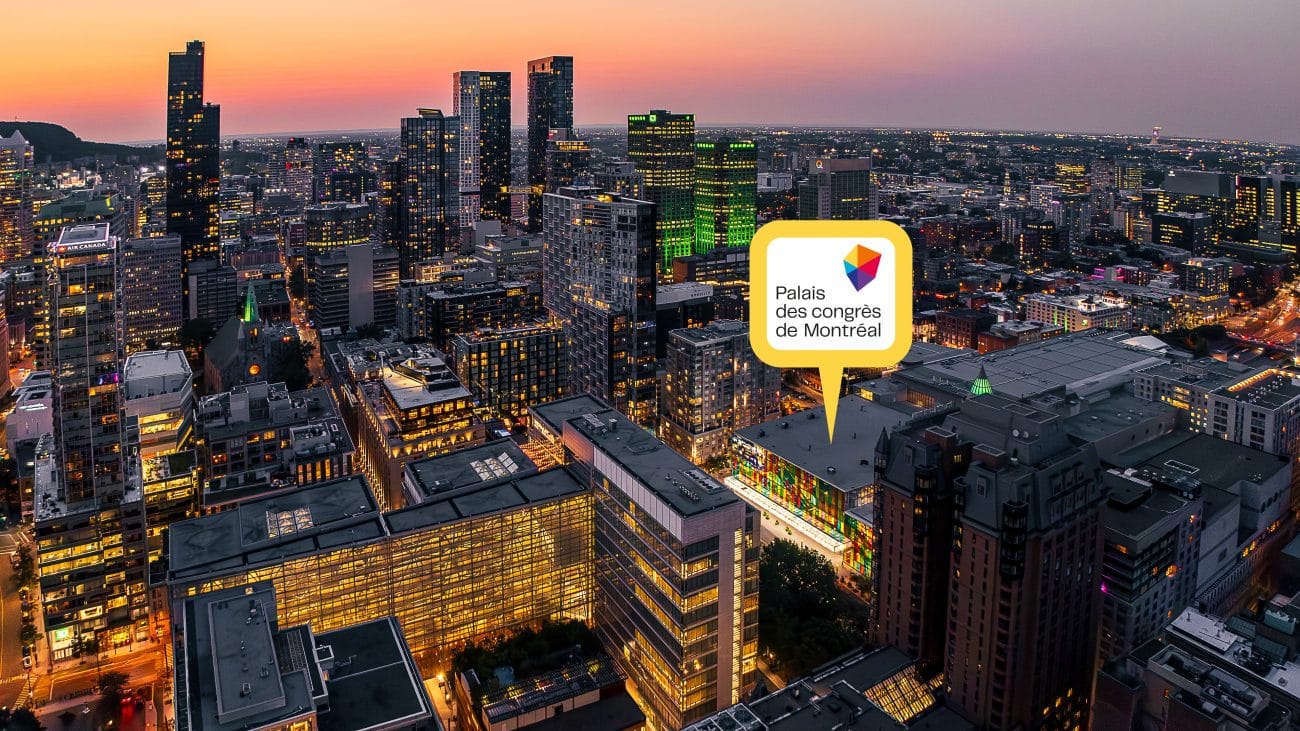
Location completes the picture. The Palais sits in downtown Montréal, placing delegates within walking distance of hotels, restaurants and much of the city’s cultural life, while Place-d’Armes metro station and Montréal’s Underground City extend that connectivity further. The city effectively becomes additional meeting space, making it easier for connections and conversations to continue beyond the formal programme.
When the Congress Leaves Something Behind
The STI & HIV 2025 World Congress offers a particularly tangible example of where that philosophy can lead.
The congress brought 1,515 participants from 72 countries to Montréal in July 2025. Getting it there, however, required more than a conventional venue agreement. In this particular case, the Palais found a way to help mitigate part of the financial risk, supporting local partners including Dr Marc Steben and the national branch of the International Union against Sexually Transmitted Infections (IUSTI) in making the Montréal edition possible. That intervention was particularly significant given the challenges of securing sponsorship for a congress addressing issues affecting marginalised populations.
Organisers subsequently reworked the participation model and secured new donors, including late-stage support from the Public Health Agency of Canada. The result was greater-than-anticipated participation, notably from lower-income countries. Indigenous knowledge and adapted research approaches were given a significant place in the programme for the first time in the congress’ history, while delegates could engage directly with Montréal’s community-based sexual-health landscape.
Then came the part that few congress balance sheets can claim. One year later, a surplus of CAD $55,151.77 is being distributed equally among six Montréal organisations working in sexual health: AIDS Community Care Montreal, Dopamine, GAP-VIES, RÉZO, Stella and Tiohtià:ke Indigenous Health Centre. Funds have also been allocated to support researchers from Canada and lower-income countries attending future international congresses, while key presentations have been made freely available online so that the knowledge generated in Montréal continues to circulate.
That example also gives substance to a word the meetings industry can sometimes use rather loosely: legacy. Here it can be counted in dollars returned to frontline organisations, wider access to scientific knowledge and new connections between an international community and the people dealing with the issue locally.
“For us, being a partner means looking beyond the event itself. It’s about understanding what an association wants to achieve, connecting the right people and helping create value that can extend well beyond the congress,” Charbonneau says.
For the Palais des congrès de Montréal, standing out is therefore beyond the building than about the role it chooses to play around it: winning the event, helping it deliver and making sure its value travels further than the closing session.
Planning an international congress? Discover what the Palais can bring to the table.