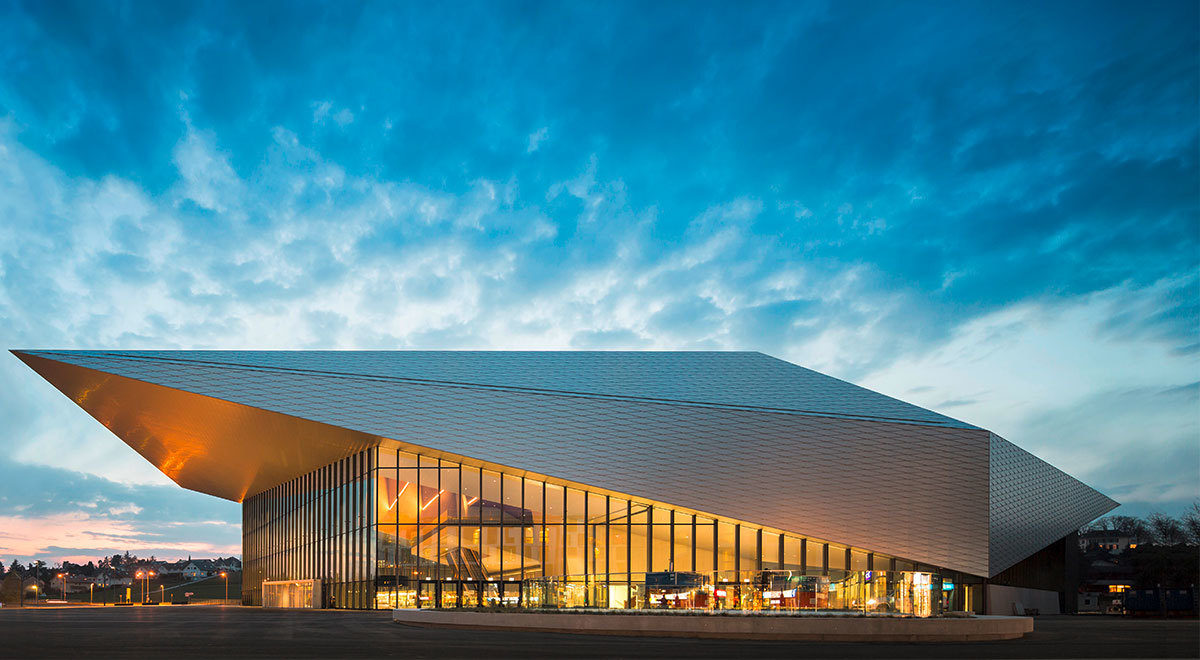
 SwissTech Convention Center
 Unlike traditional purpose-built venues, the SwissTech functions as an extension of EPFL itself. It was conceived as a “living laboratory,” where new technologies in sustainability, connectivity, and audiovisual design are trialed in real-world conditions. In that sense, the building is less a finished product than an ongoing project – part infrastructure, part testbed. For event organisers, this offers a setting that is thus reflective of the spirit of innovation that defines the institution around it.
With capacity for up to 3,000 participants, the venue includes multipurpose spaces that can be adapted for scientific congresses, corporate assemblies, or cultural events. The emphasis is on modularity rather than scale, ensuring that the Center remains accessible to smaller, more specialised gatherings as well as to international conferences.
The location adds another layer of significance. Lausanne sits within the so-called “Health Valley,” one of Europe’s densest clusters of universities, hospitals, and start-ups in life sciences and advanced technologies. The SwissTech is a short walk from the Lausanne University Hospital (CHUV), a globally recognised medical institution, and is surrounded by companies engaged in biotechnology, data science, and engineering. This proximity facilitates the kind of cross-sector dialogue that many international associations are seeking when they choose a host destination.
Lausanne itself reinforces this positioning. As both a university city and the seat of the International Olympic Committee, it brings together scientific, cultural, and sporting dimensions. The setting on Lake Geneva, bordered by vineyards listed as UNESCO World Heritage, has also made it a magnet for international organisations seeking both quality of life and accessibility.
Sustainability is another dimension where the SwissTech reflects broader shifts in the meetings industry. The venue is directly connected to public transport, incorporates photovoltaic façades, and employs intelligent energy-management systems. Accessibility has been designed into the building’s layout from the start. These features place it within the growing cohort of European venues attempting to reconcile large-scale gatherings with environmental responsibility.
In combining modular design, academic integration, and sustainability, the SwissTech Convention Center demonstrates how conference infrastructure can evolve alongside the institutions it serves. More than a backdrop for events, it reflects a region where science, business, and policy increasingly overlap – and where the role of meetings is to catalyse those exchanges rather than simply host them.
For more information, visit www.stcc.ch